Custom Logo Printing on Pickleballs: An OEM Artwork and Durability Guide
Plan custom pickleball logo printing with clear artwork, legal authorization, print zones, physical samples, rub checks and version control.
Custom logo printing on pickleballs looks like a small design task, but it connects brand ownership, curved-surface artwork, hole geometry, print adhesion, sample approval, packaging and reorder control.
A clean digital logo is not proof that it will print clearly on the finished ball. The ball’s color, material, surface, hole pattern and production process all affect the available print area and the final appearance.
For an OEM buyer, the safest route is to approve the product first, then approve artwork and a production-representative physical sample before bulk printing.
Quick answer: what does a factory need for custom pickleball logo printing?
Provide the exact ball model, intended use, destination market, proof that the buyer may use the brand assets, production-ready vector artwork, approved colors, target print size and location, quantity, packaging configuration and required delivery schedule.
The factory should confirm feasibility, prepare an artwork layout, identify any line or spacing limitations, produce the agreed sample, record the approved version and define a practical print-quality check for bulk production.
Confirm the right to use the logo before sampling
A logo can function as a trademark because it identifies the source of goods. The USPTO explains that trademarks help customers recognize and distinguish one source from another.
SYNLY should print the buyer’s own approved brand assets or artwork that the buyer is authorized to use. A request to copy an unrelated brand’s logo, product identity or confusingly similar design is not an ordinary OEM request and should not proceed without valid written authorization.
If the artwork includes a registration symbol, approval seal, league mark or certification claim, the buyer should provide the applicable authorization and approved usage rules. A factory sample does not create legal rights or product approval.
Choose the exact ball before finalizing artwork
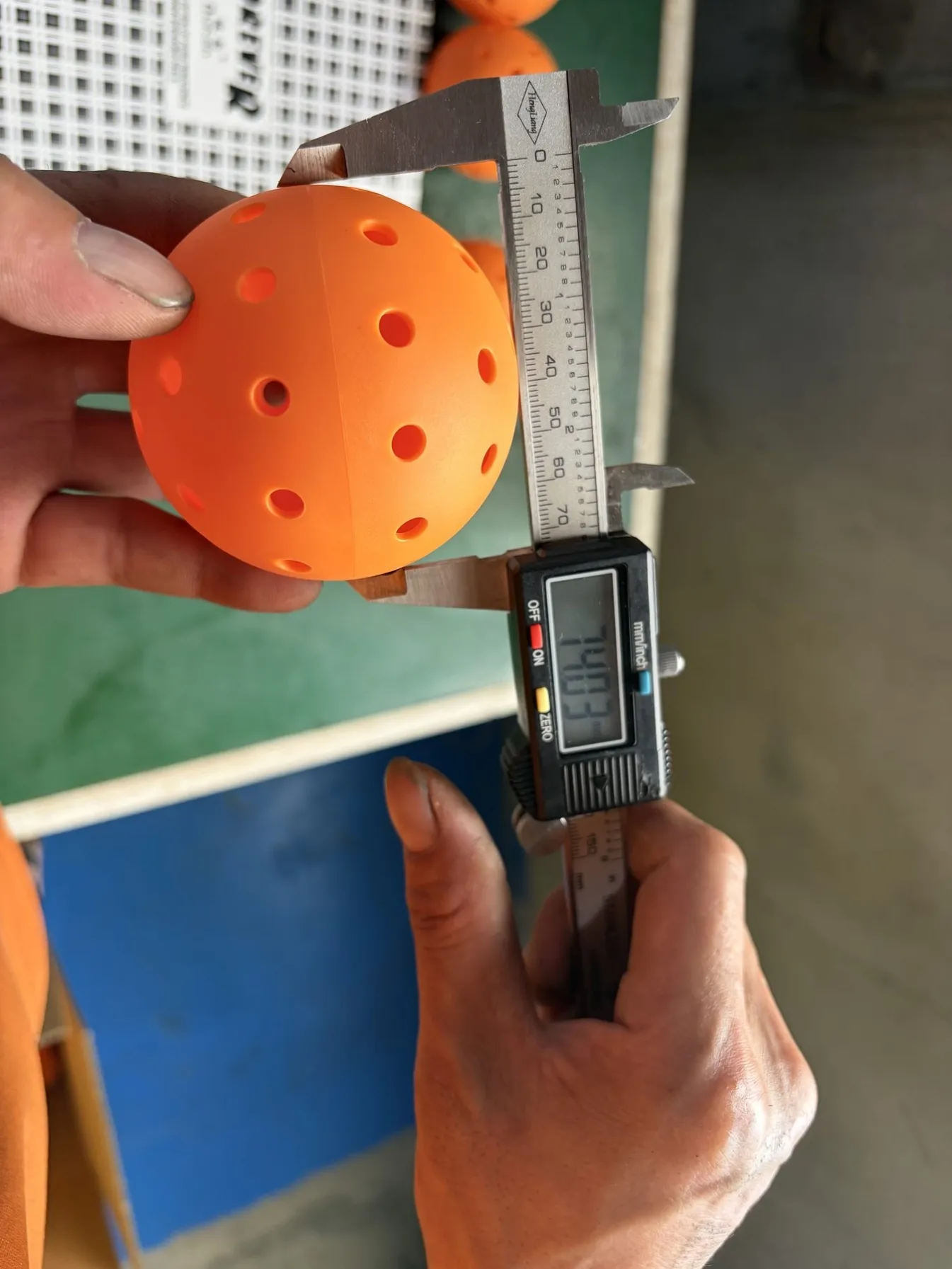
The print area depends on the physical product. A 26-hole, 40-hole or 48-hole ball can present different spaces between holes. Material, texture, seam or parting-line location and curvature can also affect placement.
Confirm:
- hole count and intended use;
- injection-molded or rotationally molded construction, when relevant;
- ball diameter and surface;
- ball color and opacity;
- visible seams or parting lines;
- approved logo zone and orientation; and
- whether one or more print positions are required.
Do not finalize a logo size from a flat mockup without checking it on the selected physical ball.
What artwork format should a buyer provide?
Vector artwork is normally the clearest production starting point because it can be scaled without losing edge quality. Common project files may include AI, EPS, SVG or production-ready PDF, depending on the confirmed workflow.
The artwork package should identify:
- final brand or logo version;
- approved colors or color references;
- minimum acceptable size;
- clear space around the logo;
- whether small text may be simplified;
- positive and reversed versions when needed;
- any symbol that must remain attached to the mark; and
- file name and revision number.
A screenshot, social-media image or low-resolution JPEG may be useful for discussion but should not be treated as the final production file.
Why do thin lines and small text matter?
Fine details that look sharp on a screen can close up, break or become uneven on a curved, perforated product. The usable detail depends on the ball, artwork, ink, process and print size.
During the artwork review, the supplier may recommend:
- increasing line thickness;
- opening small negative spaces;
- removing unreadable microtext;
- separating elements that merge at the planned size;
- using a one-color version; or
- moving the logo away from a hole, seam or high-wear location.
Any simplification should be approved by the brand owner. The factory should not redraw or alter a trademark without written approval.
How should logo color be approved?
Logo color should be judged on the actual ball color and material. The same ink can look different on fluorescent yellow, orange, blue, white or darker surfaces.
Use an agreed reference, but also approve a physical sample under suitable lighting. Record:
- ball color reference;
- ink or print color reference;
- number of colors;
- background effect from the ball;
- acceptable visual variation; and
- the lighting or physical sample used for approval.
A phone screen is not a reliable production color standard.
Which printing method should be used?
The appropriate process depends on artwork detail, number of colors, ball material, curvature, order quantity and the supplier’s confirmed production workflow. Buyers should ask which method is proposed and what limitations apply rather than assuming one method fits every design.
The project record should state:
- proposed printing process;
- print positions and count;
- ink or transfer system where relevant;
- curing or handling requirement;
- expected visual limitations;
- sample method; and
- bulk inspection criteria.
SYNLY should describe only the process confirmed for the specific order. If any printing or finishing step is subcontracted, responsibility for sample approval and final quality must still be clear.
How should print durability be evaluated?
A pickleball repeatedly contacts paddles, courts, bags and packaging. No responsible supplier should promise that every printed mark will remain visually unchanged forever.
Instead, define a practical check. Depending on the project, buyers may review:
- adhesion after curing;
- dry rub using an agreed material and number of cycles;
- resistance to ordinary handling and packing;
- appearance after a controlled play or impact trial;
- transfer or smudging inside the package; and
- comparison with the approved sample.
Record the method, sample count and acceptance criteria. “Rub resistant” is too vague unless both sides know how it was tested.
Approve a physical sample, not only a digital mockup
A digital layout can confirm size, orientation and approximate position. It cannot fully confirm print sharpness, adhesion, color on the ball, hole clearance or visual balance on a curved surface.
The approved sample record should include:
- ball model, structure and color;
- sample or revision code;
- artwork file name and version;
- print size and positions;
- print color reference;
- photographs from multiple angles;
- agreed durability check and result;
- packaging version; and
- approval date and approver.
If the physical sample differs from the mockup, approve the final physical result and corrected production file together.
Connect logo approval with packaging and batch records
The logo on the ball should match the product name, SKU, barcode, pack count and artwork shown on the packaging. A correct ball placed in the wrong retail box is still the wrong commercial product.
Before production, cross-check:
- ball logo and model identity;
- retail packaging artwork;
- barcode and SKU;
- quantity and color per pack;
- inner and master carton labels;
- country and market information supplied by the buyer; and
- batch or production reference.
Keep the artwork revision with the purchase order and traceability record so that a reorder does not rely on an old email attachment.
What if the ball is intended for sanctioned competition?
Approval is model-specific and can involve marking, licensing and final production-ready identity requirements. The current USA Pickleball equipment manual, submission instructions and approved ball list should be reviewed for the exact model.
Do not print or advertise an approval seal before the relevant authorization is granted. Changing the product identity, model, construction or significant graphics may also require a new review depending on the governing body’s current rules.
SYNLY does not currently represent its 48-hole ball as USA Pickleball approved. It is available for bulk production and all colors can be customized, subject to sample, artwork, specification, MOQ and order confirmation.
A practical pre-production logo checklist
Before bulk printing, confirm:
- Buyer has the right to use the supplied logo and symbols.
- Exact ball model, structure, color and intended use are approved.
- Vector artwork and revision number are recorded.
- Print size, position, orientation and color are approved.
- Holes, seams and curvature have been checked on the physical ball.
- The proposed printing process and limitations are documented.
- A physical sample has been approved.
- The durability check and acceptance rule are written.
- Packaging, SKU and barcode use the same product identity.
- Any approval mark is used only with documented permission.
Frequently Asked Questions
Can SYNLY print a custom logo on pickleballs?
SYNLY can discuss logo printing for suitable pickleball models. Feasibility, print method, colors, sample cost, MOQ, packaging and lead time depend on the product and artwork.
Is a vector logo required?
It is strongly preferred for production because it scales cleanly and makes line, spacing and color adjustments easier. The final accepted file format should be confirmed for the project.
Can a multi-color logo be printed?
It may be possible, but the answer depends on artwork, registration, size, ball surface, print process, quantity and cost. A simplified one-color version may produce a clearer result on some balls.
Can the factory copy a famous brand logo on a ball?
Not as an ordinary OEM service. The buyer must have valid authorization to use third-party trademarks, seals or protected artwork.
Will the printed logo never wear off?
No responsible supplier should make an unlimited promise. Agree on a realistic handling or rub test, sample count and acceptance criteria for the intended use.
Does a printed approval logo make a ball tournament approved?
No. Approval must be granted for the exact model through the current official process. A printed seal without authorization does not create approval.
Request a Custom-Logo Sample Review
Send the exact product, intended use, destination market, proof that the brand assets may be used, vector artwork, print colors, quantity, packaging plan and delivery schedule. SYNLY can then review the print zone, sample method and project-specific quotation.
Email: parry@synlypickleball.com
WhatsApp: +86 15067540770
Related pages:
- OEM packaging checklist
- Pickleball ball sample testing guide
- Pickleball batch traceability guide
- Browse SYNLY products
- Contact SYNLY
References:
- USPTO trademark basics: https://www.uspto.gov/trademarks/basics/what-trademark
- USA Pickleball rules and equipment standards: https://usapickleball.org/rules/
- USA Pickleball approved ball list: https://equipment.usapickleball.org/ball-list/