Sep 2, 2026Manufacturing Process
OEM Pickleball Packaging Checklist for Wholesale Buyers
A practical OEM pickleball packaging checklist covering logo files, pack counts, labels, barcodes, cartons, samples and approval before bulk production.
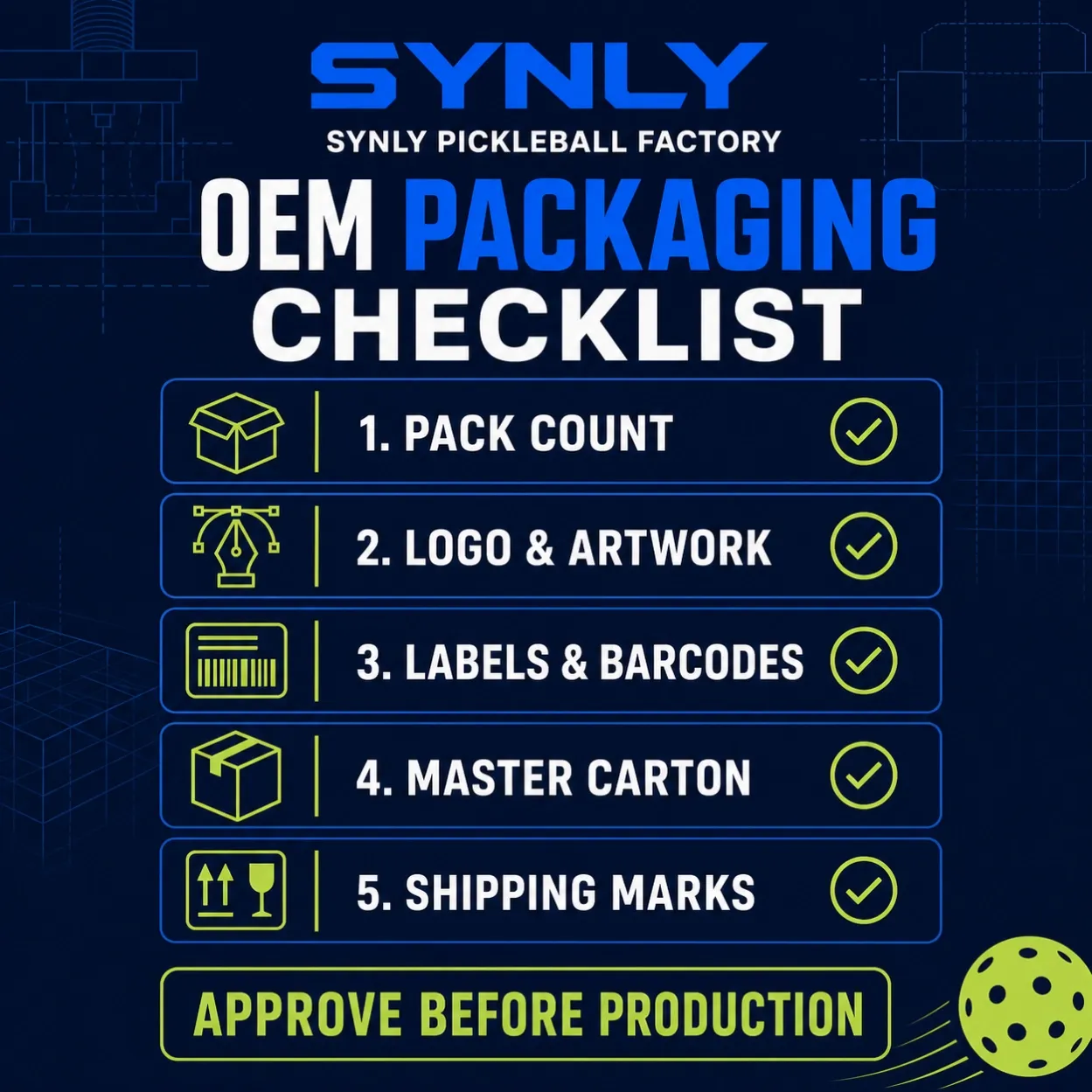
Custom packaging is more than a printed logo. For a wholesale pickleball order, the packaging specification connects the product, sales channel, warehouse and final customer. If the pack count, barcode, carton mark or artwork version is unclear, a correct ball can still arrive as the wrong retail product.
The best time to confirm packaging is before bulk production. This checklist gives clubs, distributors and private-label buyers a practical starting point for discussing a project with a manufacturer.
1. Define the sales unit first
Start with the unit the customer will actually buy or receive. Examples include a three-ball pack, a six-ball box, a 12-ball pack or a bulk club carton. Also confirm whether the order is intended for retail shelves, e-commerce fulfillment, club use, tournament use or distributor stock.
The sales unit affects the package dimensions, label area, barcode location and number of units in each master carton. It should be agreed before artwork is finalized.
2. Provide production-ready brand files
Send the logo in a vector format when possible. Confirm the approved brand colors, the permitted print area and whether the logo will appear on the ball, the retail package, the master carton or all three.
A useful artwork file should identify:
- the final logo version;
- color references;
- print size and placement;
- required clear space;
- front, back and side panels;
- any text that must not be changed.
Do not rely only on a small screenshot. A clear file and an approved layout reduce interpretation during production.
3. Choose the packaging structure
Common options include bags, tubes, folding boxes and bulk cartons. The right format depends on the sales channel, pack count and storage method. Buyers should confirm how the package will be opened, displayed, stacked and shipped.
Ask the supplier to identify which parts are standard and which parts require customization. A custom structure, printed insert or special material can affect minimum quantity, sampling and production time.
4. Confirm all label information
Create one approved list of required information instead of adding text in separate messages. Depending on the destination and sales channel, this may include:
- brand and product name;
- model or SKU;
- quantity per pack;
- color;
- country of origin;
- importer or distributor information;
- warning or care information;
- barcode;
- lot or batch reference.
Legal and marketplace requirements vary by destination. The buyer should confirm the rules that apply to the target market and provide the final approved wording.
5. Supply valid barcode data
If a UPC, EAN or other barcode is required, the buyer should supply the valid number and confirm which SKU it belongs to. The artwork should leave enough quiet space around the barcode, and the printed sample should be checked for legibility and scanning.
Do not reuse one barcode for different pack counts or product variants unless the buyer's inventory system explicitly permits it.
6. Approve a sample before bulk production
The approval method should match the amount of customization. Depending on the project, buyers may review artwork, photographs, video or a physical packaging sample.
The approval record should cover:
- product color and quantity;
- logo placement and print quality;
- package size and structure;
- label text and barcode;
- accessories or inserts;
- the exact pack-out sequence.
Keep the approved version number with the purchase order so that both sides refer to the same file.
7. Specify the master carton and shipping marks
Retail packaging and export cartons solve different problems. Confirm the number of sales units per master carton, carton dimensions, gross and net weight fields, and any required shipping marks.
Useful carton marks may include the purchase order, SKU, product color, quantity, carton number and destination reference. The exact format should match the buyer's warehouse or freight requirements.
8. Use one final pre-production checklist
Before production begins, place the product specification, packaging specification and approved artwork in one final record. At minimum, confirm:
- ball type, color and quantity;
- units per retail package;
- retail packages per master carton;
- logo and artwork version;
- barcode and label text;
- carton marks;
- sample approval status;
- inspection requirements;
- requested shipment window.
This does not eliminate every production risk, but it makes responsibilities and approval points easier to verify.
Frequently asked questions
Can SYNLY customize pickleball logos and packaging?
SYNLY discusses logo, color and packaging requirements according to the product, order volume and requested design. Send the intended product, sales channel and estimated quantity for a project-specific review.
Can packaging be sampled before bulk production?
Yes. An approval step can be arranged according to the customization scope. The appropriate method may be artwork confirmation, photographs, video or a physical sample.
Who should provide the barcode?
The buyer should normally provide the valid barcode number and confirm the corresponding SKU and pack count. The supplier can place the approved barcode in the packaging artwork.
Does custom packaging affect minimum quantity and lead time?
It can. The answer depends on the packaging structure, printing method, materials and order quantity. Confirm these points after the specifications are clear.
What information should I send for a packaging quotation?
Send the target market, sales channel, product, pack count, estimated quantity, logo files, label requirements and preferred packaging format. SYNLY can then review the scope and identify any missing specifications.
Discuss an OEM packaging project
Explore SYNLY custom pickleball products, review the current pickleball and paddle range, or contact SYNLY to discuss a packaging project.
Send your target market, product, pack count, branding files and estimated quantity to parry@synlypickleball.com, or contact SYNLY on WhatsApp at +86 150 6754 0770.