Sep 2, 2026Pickleball Innovation
Matte vs Smooth Pickleballs: Surface Feel, Control and 48-Hole Bounce
A careful discussion of surface friction, early-use feel, wear and measurement limits, plus why bounce consistency remains more important than finish alone.
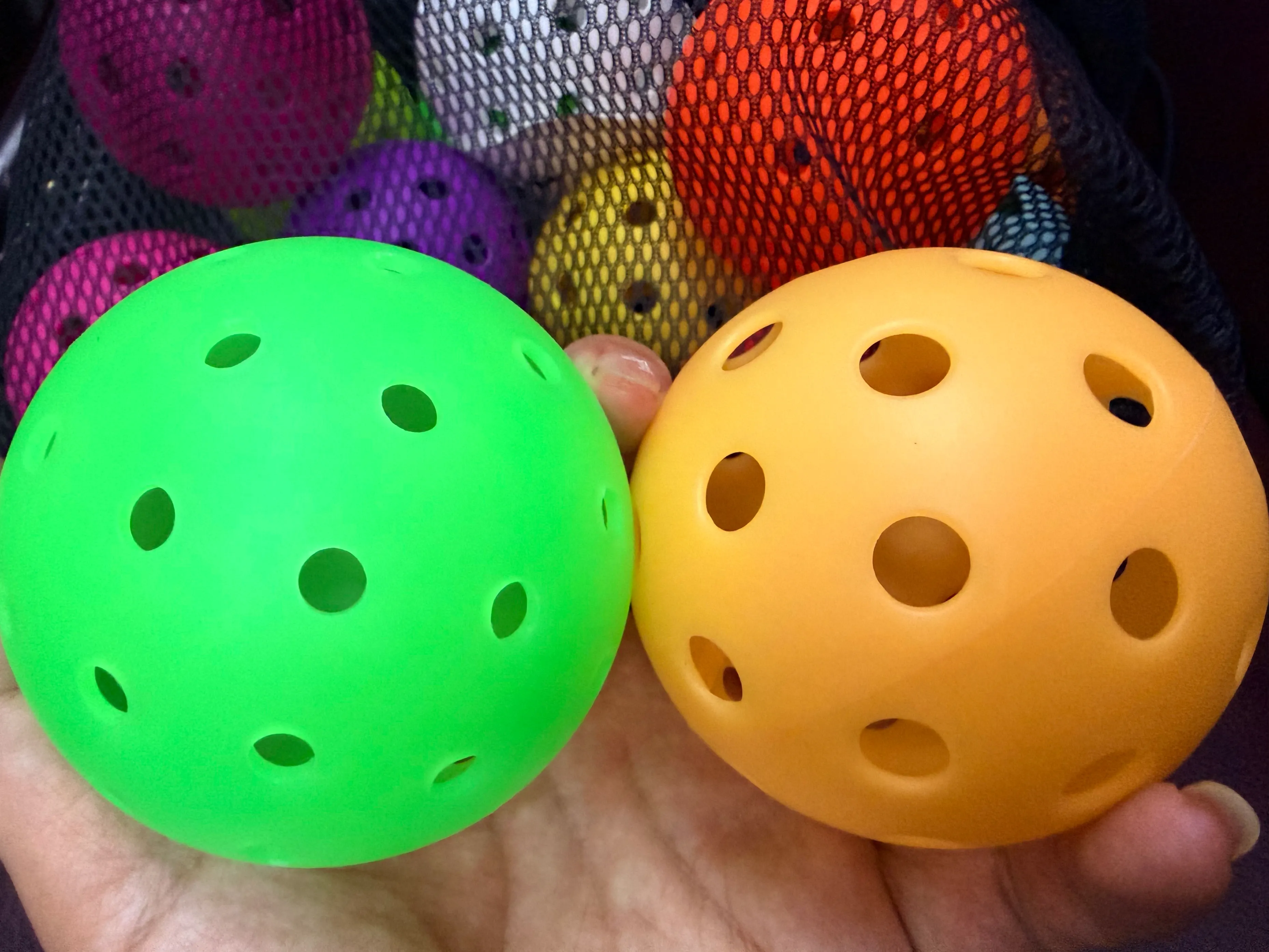
Put two pickleballs in your hand and the difference can feel obvious. In our photo, the green ball on the left has a matte-looking finish, while the orange ball on the right feels smoother. The first reaction is often that the matte ball must create more friction and therefore more control.
That idea is worth testing, but it should not be treated as a proven rule.
Matte feel is not the same as measurable control
A surface that feels less slippery in the hand may give players a different impression. During play, however, the ball is in contact with the paddle for only a short moment. Paddle face texture, swing speed, impact angle, ball material, temperature, wear and dirt can all influence the result.
This is why we would not describe every matte-looking ball as easier to control or every smooth ball as better in the hand. Some players may prefer one feel, but preference and measured performance are not the same thing.
There is also an important standards point. USA Pickleball's equipment standard describes an approved ball as having a smooth molded surface free of texturing. A ball can look matte because of color, resin or molding conditions without having an intentionally rough texture. If a surface is deliberately textured, it needs careful review before anyone describes it as suitable for sanctioned competition.
How we would compare the two surfaces
A useful comparison should keep the other variables as close as possible:
• Same diameter, weight and hole pattern
• Same material family and production batch
• Bounce measured at a controlled temperature
• Roundness before and after repeated play
• Spin and flight checked with repeatable strokes
• Wear, cracking and softening recorded over time
• Blind player feedback, without telling testers which finish is expected to perform better
This approach separates appearance and hand feel from actual court performance.
What we observed with 48-hole samples
We have also been comparing 48-hole pickleballs from the market with 26-hole and 40-hole reference balls. In the samples we tested, a recurring weakness was lower rebound in several 48-hole designs.
This is a SYNLY factory observation, not a claim that every 48-hole ball behaves the same way. Bounce depends on the complete system: polymer formulation, wall thickness, hole geometry, molding process and temperature.
After several material and process revisions, our current 48-hole prototype shows much stronger elasticity in internal checks while keeping the design features we wanted to explore. The next step is not a marketing slogan. It is durability, roundness and batch-consistency testing with clubs, coaches and distributors.
The current USA Pickleball ball standard specifies 26 to 40 holes, so a 48-hole prototype should not be presented as an approved tournament ball under that standard. We see it as a development project for testing and recreational applications unless standards and approval status change.
Join the test
If your club, association or distribution team regularly compares pickleballs, we would value practical feedback. Tell us what matters most in your market: bounce, spin, sound, visibility, cold-weather performance, hot-weather stability or service life.
FAQ
Is a matte pickleball always easier to control?
No. A matte-looking finish can feel different in the hand, but control also depends on the paddle, impact, material, temperature and wear. It needs comparative testing.
Does a smooth pickleball always feel better?
That is subjective. Some players prefer a smoother hand feel, while others prefer a drier or less slippery feel.
Are all 48-hole pickleballs less bouncy?
No. SYNLY observed lower rebound in several market samples, but bounce varies with formulation, geometry and process. Our latest prototype has improved significantly after multiple revisions.
Is SYNLY's 48-hole ball USA Pickleball approved?
No. The current USA Pickleball standard specifies 26 to 40 holes. Our 48-hole model is a development prototype for testing and non-sanctioned applications.
Can clubs or distributors join the testing?
Yes. We welcome structured feedback on bounce, durability, roundness and consistency. Contact us to discuss a sample test.