Portable Pickleball Net Buying Guide: What Clubs and Event Organizers Should Check
Compare portable pickleball nets by standard dimensions, net height, frame stability, assembly, transport, spare parts and OEM branding.
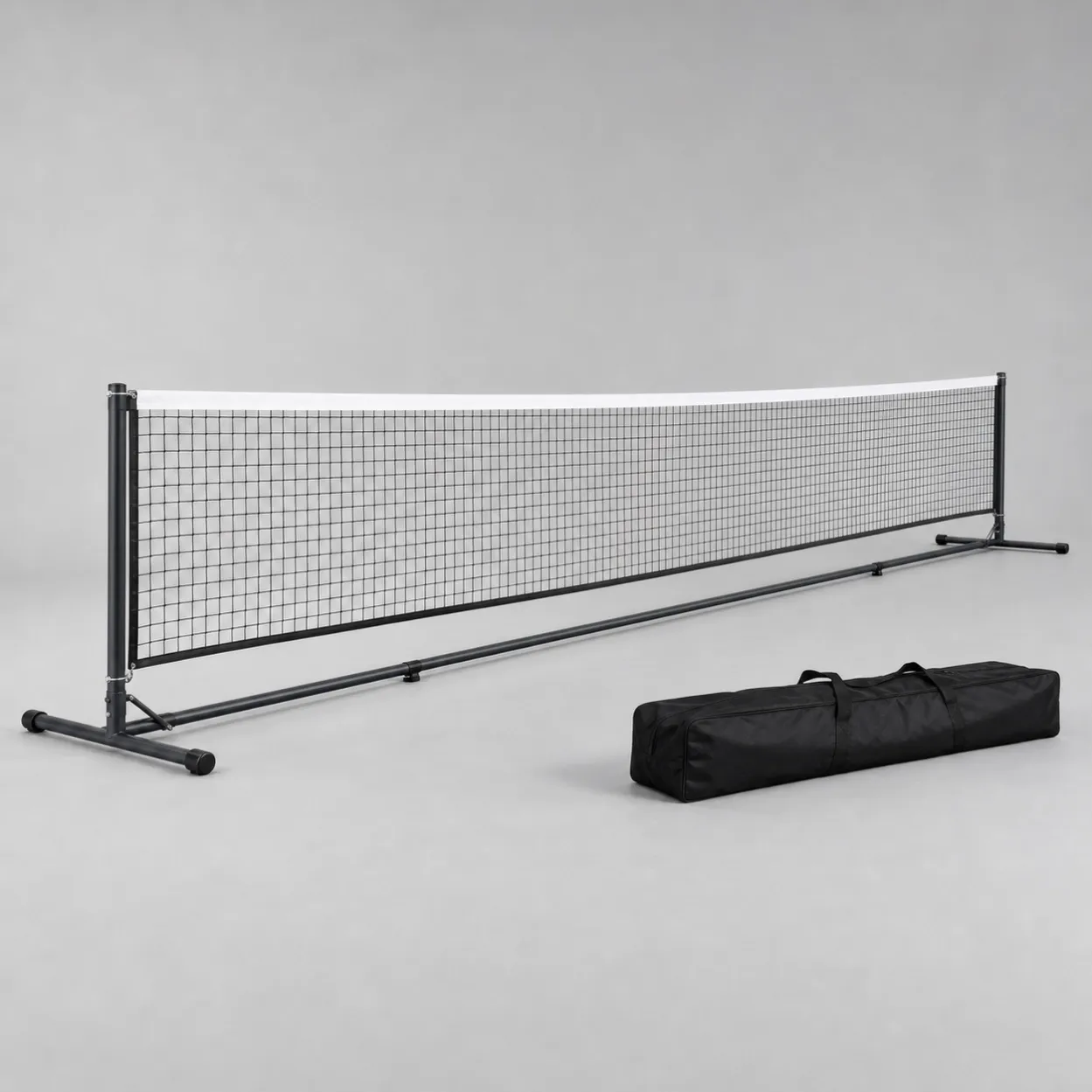
A portable pickleball net should do more than span the court. It should reach the required height after assembly, remain stable during repeated play, pack and move efficiently, and be simple enough for staff or volunteers to set up consistently.
For clubs, coaches, event organizers and distributors, the best portable pickleball net is therefore not automatically the cheapest or the heaviest. It is the system that fits the intended court, setup frequency, transport method, user group and maintenance plan.
This guide explains the measurements and practical checks buyers can use before approving a sample or placing an OEM order.
What is the standard size of a pickleball net?
USA Pickleball’s published court guidance says the posts should be 22 feet, or about 6.71 meters, apart. The net should be at least 21 feet 9 inches, or 6.63 meters, long and at least 30 inches high. After installation, the top should measure 36 inches at the sidelines and 34 inches at the center.
Those dimensions provide a useful reference, but a product’s listed width alone does not prove that the assembled system will meet every requirement. Buyers should measure a real sample on a flat surface and confirm the intended event or market rules before describing a net as suitable for sanctioned competition.
SYNLY’s catalog includes a full-size 6.7-meter portable net system with a steel frame, 22-millimeter tubing and a carry bag. Final dimensions, construction, packaging and labeling should be confirmed in the approved order specification.
Why is assembled height more important than the box description?
A supplier may list the total frame width, net fabric width or shipping-package length. These are not the same measurement. The useful question is whether the fully assembled net reaches the target height at the sidelines and center while maintaining appropriate tension.
When evaluating a sample:
- Assemble it according to the supplied instructions.
- Place it on the type of surface where it will normally be used.
- Measure at both sidelines and at the center.
- Repeat the measurements after several practice sessions.
- Record whether the center sags as joints settle or the top tape stretches.
A repeatable setup is especially important when volunteers, coaches or venue staff will assemble several courts in a short period.
What determines frame stability?
Tube diameter is one factor, but it is not the whole answer. Stability also depends on wall thickness, material, joint design, foot geometry, center support, total weight and how the net tension loads the frame.
Ask the supplier to explain:
- Frame material and tube dimensions.
- How the sections connect and whether they can be assembled in the wrong order.
- The width and shape of the feet.
- Whether the center support holds the target center height.
- How the frame behaves when moved after assembly.
- Which parts are most likely to wear and whether replacements are available.
Outdoor users should also consider wind. A portable system should not be assumed safe in strong wind simply because it feels stable indoors. The organizer remains responsible for site conditions, placement and safe use.
Which parts deserve the closest sample inspection?
Connectors and joints
Repeated assembly concentrates wear at push buttons, sleeves and tube ends. Check whether sections fit securely without excessive force and whether the joint develops play after repeated cycles.
Center support
The center support affects height and sag. Confirm that it sits correctly on the intended surface and does not create a sharp edge that can damage the lower net.
Feet and base frame
Look for rocking, twisting and sharp contact points. A system that is stable on a smooth indoor floor may behave differently on an outdoor court with joints or minor unevenness.
Mesh, top tape and edge binding
Inspect stitching, tension, mesh openings, tape alignment and the points where fabric attaches to the frame. The net material should not allow a pickleball to pass through.
Carry bag
For portable use, the bag is part of the product rather than an afterthought. Check zipper quality, handle reinforcement, fabric, internal space and whether staff can repack all components without forcing them.
How should clubs test setup time?
Use the people who will actually handle the equipment. A supplier demonstration by an experienced assembler can make a system look faster than it will be at a club or event.
Run at least three setup-and-pack cycles and record:
- Number of people required.
- Time from opening the bag to a measured, ready-to-play net.
- Time required to repack it.
- Steps that cause confusion.
- Parts that are easy to lose or install backwards.
- Whether instructions remain readable after transport.
For multi-court events, multiply the real setup time by the number of systems and include a margin for new volunteers, missing parts and adjustment.
What should distributors confirm before an OEM order?
An OEM net project needs more than a logo position. The specification should identify:
- Assembled width and height targets.
- Frame material, tube diameter and other agreed construction details.
- Net fabric, top tape, binding and attachment method.
- Center support and tensioning method.
- Component count and assembly instructions.
- Carry-bag material, dimensions and branding.
- Carton quantity, carton dimensions and gross weight.
- Logo artwork, label language and packaging marks.
- Sample-approval method and batch-inspection plan.
- Spare-parts policy for connectors, frame sections, nets and bags.
The approved sample and written specification should be used together. A photo alone cannot define fit, height, stability or packing completeness.
Is a 6.7-meter portable net automatically tournament approved?
No. A 6.7-meter width can be designed around the standard court span, but a listed dimension does not by itself create approval or guarantee compliance after setup.
Tournament organizers should confirm the current rules, measure the assembled net, verify any equipment-list requirements and decide whether the system is suitable for the specific event. SYNLY describes the product factually as a full-size portable net system and does not claim governing-body approval for this model.
When does a portable net make the most sense?
- Clubs that convert shared courts.
- Schools and community programs.
- Coaches running temporary practice sessions.
- Events using venues without permanent posts.
- Distributors serving recreational and club customers.
- Brands building coordinated pickleball-equipment packages.
Permanent courts may prioritize fixed-post performance, while mobile programs may value transport, fast assembly and replaceable parts. The intended use should guide the specification.
Frequently Asked Questions
How wide should a standard pickleball net be?
USA Pickleball’s published guidance places the posts 22 feet, or about 6.71 meters, apart and calls for a net at least 21 feet 9 inches, or 6.63 meters, long. Measure the assembled product rather than relying only on its model name.
What height should a pickleball net be?
The published reference is 36 inches at the sidelines and 34 inches at the center. Check both positions after assembly and again after the net has been used.
Is thicker tubing always better?
Not by itself. Tube diameter, wall thickness, material, joint fit, feet, center support, net tension and total design work together. A sample test is more useful than comparing one number.
What should be included with a portable pickleball net?
Confirm every frame section, net, center support, fastener, instruction sheet and carry bag. Buyers should also ask which replacement components can be supplied separately.
Can SYNLY customize portable pickleball nets?
SYNLY can discuss OEM branding, labels and packaging for portable net projects. Construction details, order quantity, artwork, sample approval, price and lead time must be confirmed for each project.
Can buyers visit the factory?
Factory visits can be arranged by appointment. Buyers can discuss the products, quality-control plan, OEM/ODM requirements and production arrangements relevant to their project.
Request a Portable-Net Specification
Tell SYNLY how the net will be used, how often it will be assembled, how many courts are planned, the target market, packaging needs and branding requirements. We can then discuss the suitable configuration, sample plan and quotation.
Email: parry@synlypickleball.com
WhatsApp: +86 15067540770
Related pages:
References: USA Pickleball rules and court and net guidance.