Aug 7, 2026
What Makes a High-Quality Pickleball? Materials, Molding & Factory Testing
Learn how polymer selection, molding control and factory testing affect pickleball bounce, durability, roundness and batch consistency.
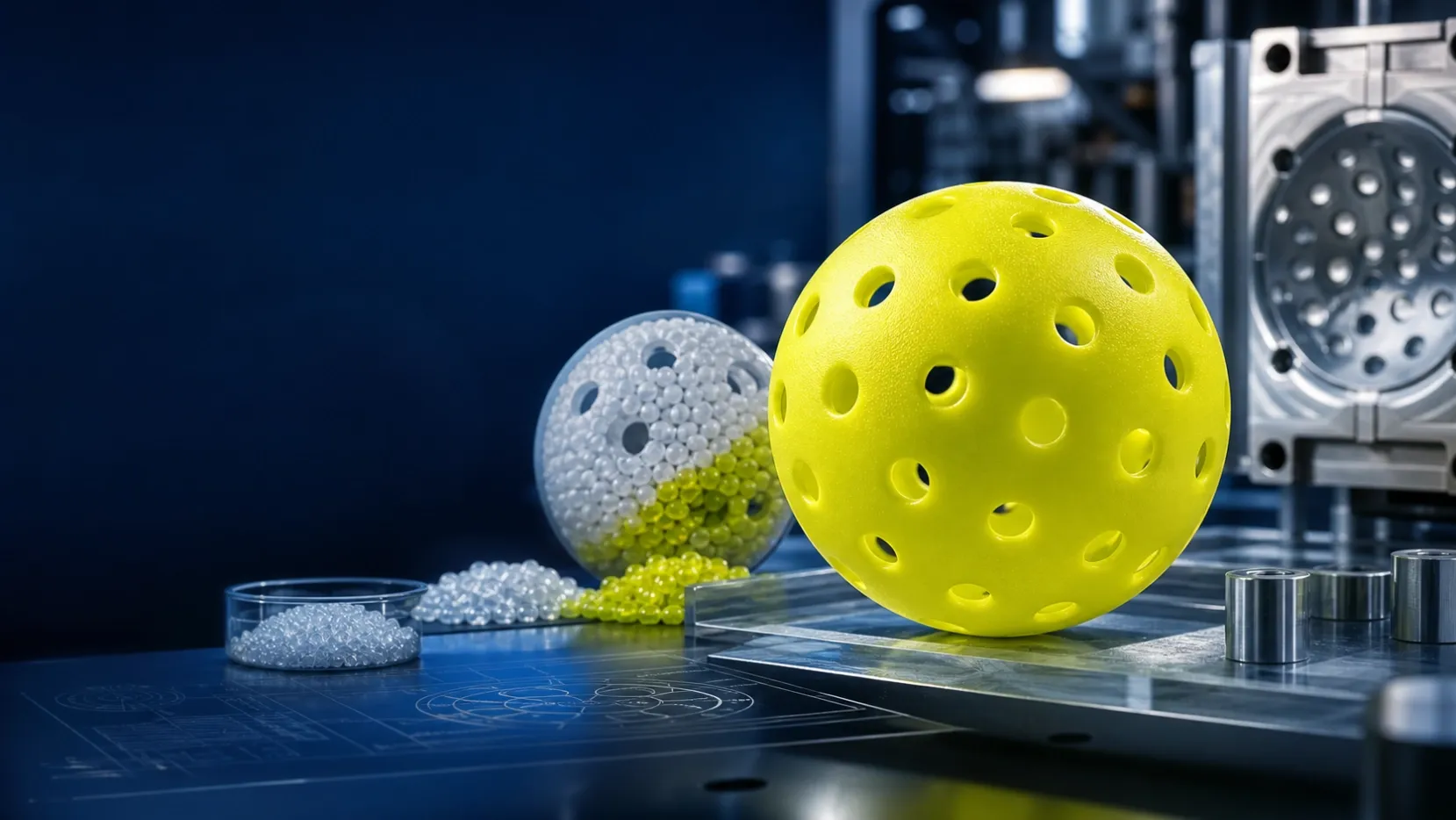
A pickleball looks simple: a small hollow plastic sphere with precisely arranged holes. Yet its performance is the result of several interdependent decisions. Which matters most—the molding process, the polymer itself, or quality control during production?
Based on more than 30 years of injection-molding experience, our view at SYNLY is clear: material selection comes first. Process engineering determines how well that material is transformed, and disciplined quality control determines whether every production batch performs consistently. A reliable ball needs all three, but the material sets the performance ceiling.
What Defines a High-Quality Pickleball?
For players and OEM buyers, quality is not a single specification. It is the balance of flight stability, bounce consistency, roundness, durability, impact resistance and dependable performance across changing temperatures.
A ball may look correct when it leaves the mold but still crack early, soften in heat, become brittle in cold or produce inconsistent bounce. These problems often begin at the material-development stage.
1. Polymer Materials Set the Performance Ceiling
The polymer formulation affects stiffness, elasticity, impact strength, rebound, fatigue resistance and temperature sensitivity. Base resin quality matters, but so do the complete formulation, additives, blend consistency and the relationship between material properties and product geometry.
In our manufacturing experience, even excellent equipment cannot fully compensate for the wrong material. A stable molding process may produce a visually consistent ball, but if the polymer becomes brittle in cold weather or overly soft in high heat, the finished product will still underperform.
What we evaluate during material development
- Impact resistance and resistance to cracking
- Elastic recovery and bounce consistency
- Stiffness without excessive brittleness
- Dimensional stability after molding
- Performance across cold and hot conditions
- Repeatability between raw-material batches
2. Injection-Molding Expertise Turns Material Potential Into Performance
Material alone is not enough. The molding process must control how the polymer flows, cools and solidifies. Tooling design, gate strategy, wall-thickness balance, processing temperature, pressure, cooling time and mold precision all affect the finished ball.
SYNLY is now applying three decades of injection-molding knowledge to pickleball development. Our goal is not simply to make a plastic sphere. It is to understand how material behavior, hole geometry and process parameters work together to create repeatable performance.
Why process control matters
Small variations can change roundness, weight distribution, seam quality, local stress and rebound. Experienced process engineering helps reduce those variations and makes material innovations manufacturable at scale.
3. Quality Control Protects Consistency
If materials define potential and process engineering shapes the product, quality control protects the result. Buyers do not need one excellent sample; they need dependable performance across thousands of balls and repeated production orders.
Effective production control should monitor incoming materials, key molding parameters, dimensions, weight, roundness, visual quality, bounce behavior and durability. When a deviation appears, the factory must be able to trace it to the material, tooling, equipment setting or production environment.
Our 48-Hole Pickleball Development Goal
SYNLY is developing a 48-hole pickleball concept designed around real match-play needs and manufacturability. The project is still in development, and our target is ambitious: improved durability, responsive bounce and stable behavior in both severe cold and extreme heat, while meeting the dimensional and performance requirements expected for competitive play.
The number of holes is only one design variable. Hole diameter, distribution, aerodynamic balance, wall structure, material formulation and molding consistency must be developed as one system. Our 30 years of injection-molding experience gives us a strong foundation, but testing and material collaboration are essential to reaching the final target.
Why Temperature Resistance Matters
Temperature changes polymer behavior. Cold conditions can increase brittleness and raise the risk of cracking, while high heat can soften some formulations and alter bounce or flight. For brands selling across different markets and seasons, climate stability is therefore a product requirement—not a marketing detail.
Our development objective is to identify material and structural combinations that maintain more consistent performance through demanding environmental changes. Claims will be based on validation, not assumptions.
Open Collaboration: Bring the Formula or Idea, We Help Make It Real
A factory has the most value when it can turn a technical concept into a repeatable product. We welcome discussions with polymer specialists, material suppliers, engineers, pickleball brands and product developers who have promising formulations, performance targets or design ideas.
You can bring a material formula, parameter proposal, technical concept or market requirement. SYNLY can support feasibility discussion, prototyping, tooling, process development, testing and production planning. Together, we can move from idea to manufacturable solution.
Beyond Pickleballs
Our development scope is not limited to the ball itself. SYNLY is also interested in OEM/ODM collaboration for pickleball equipment, accessories and related derivative products. The same manufacturing principle applies: start with a real user need, select appropriate materials, engineer a reliable process and control quality throughout production.
Frequently Asked Questions
What is the most important factor in pickleball quality?
Materials, process and quality control all matter. Based on SYNLY's 30 years of injection-molding experience, material selection and formulation come first because they define the product's potential for impact resistance, elasticity, durability and temperature stability.
Can a better molding process compensate for poor raw material?
Only to a limited extent. A controlled process can improve consistency and appearance, but it cannot fully correct a polymer formulation that is too brittle, too soft or unstable across temperatures.
Why is quality control important during pickleball production?
Quality control helps ensure that weight, dimensions, roundness, bounce and durability remain consistent from sample approval through mass production. It also makes deviations traceable.
What is special about SYNLY's 48-hole pickleball project?
The project explores how 48-hole geometry, polymer formulation and precision molding can work together to improve durability, bounce and climate stability. It remains under development and will be validated through testing.
Can a pickleball perform consistently in both cold and hot weather?
Temperature affects polymer behavior, so consistent performance requires the right formulation, structure and processing window. Improving cold- and heat-weather stability is one of SYNLY's key development targets.
Does SYNLY accept material-formula or technical-development partnerships?
Yes. We welcome discussions with material suppliers, engineers, brands and product developers. Partners can bring a formulation, parameter set, product target or concept, and we can help evaluate and translate it into a manufacturable solution.
Can SYNLY support products beyond pickleball balls?
Yes. We are open to OEM/ODM development for pickleball equipment, accessories and related products, subject to technical feasibility and project requirements.
Turn Your Pickleball Idea Into a Manufacturable Product
Are you developing a more durable ball, a climate-resistant polymer formula, a private-label product or a new pickleball accessory? Share your target, material concept or technical challenge with SYNLY.
Let our 30 years of injection-molding experience help move your idea from concept to tooling, testing and production.