Aug 8, 2026Manufacturing Process
How to Evaluate Pickleball Paddle Samples Before a Bulk Order: A B2B Checklist
Before placing a bulk paddle order, clubs, distributors and brands should test more than surface material and price. Use this practical checklist to compare approval status, weight tolerance, grip, co
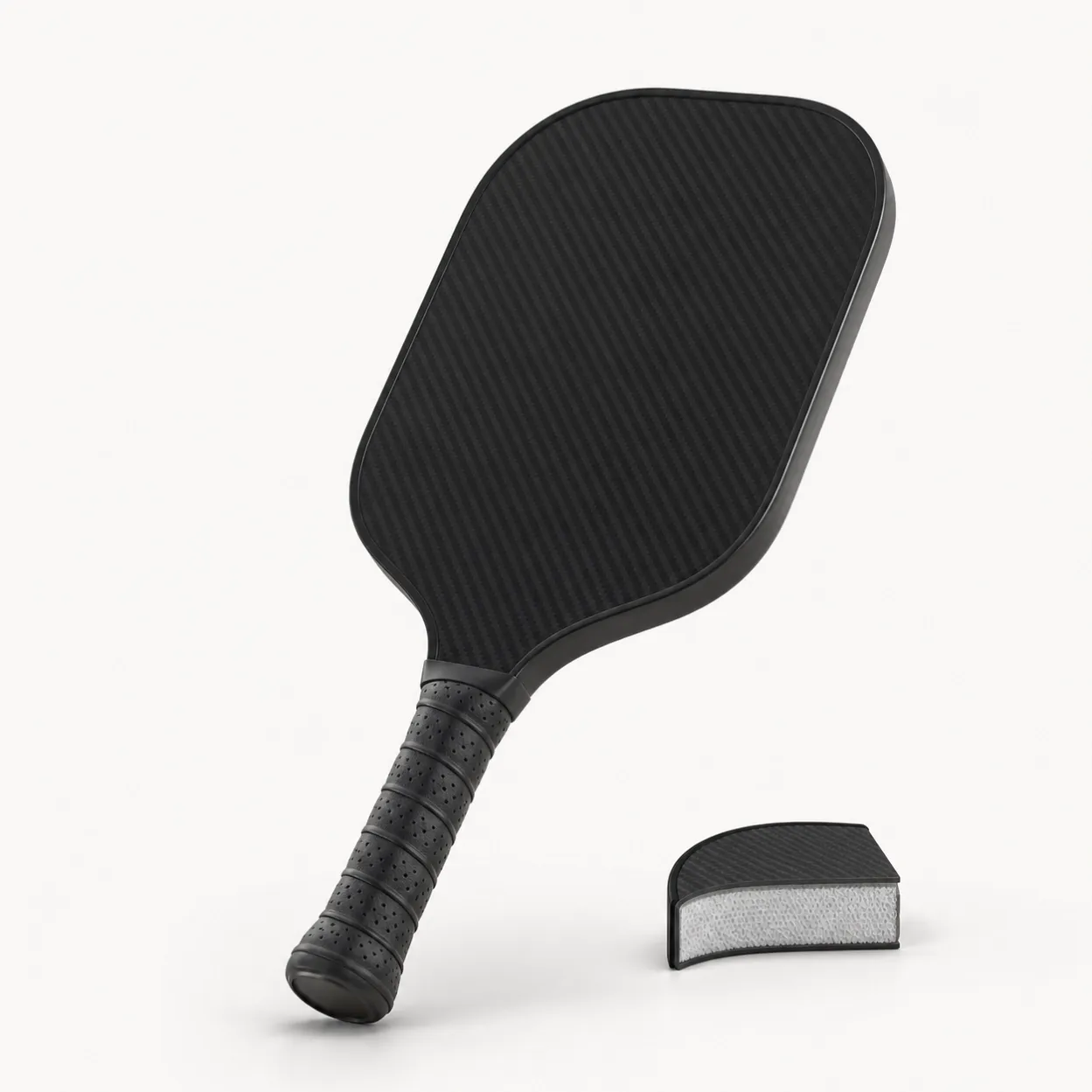
Choosing a pickleball paddle for personal use is largely about preference. Choosing a paddle for a club, distributor, private-label brand or retail program is different: the sample must represent a product that can be manufactured consistently across an entire order.
That is why a B2B buyer should never approve a paddle from a product photo or specification sheet alone. The right process is to define the target player, compare physical measurements, conduct structured play testing and confirm that the production standard can match the approved sample.
This guide explains what to test before you approve an OEM pickleball paddle for bulk production.
1. Confirm the intended market before testing the sample
The same paddle cannot be ideal for every buyer. Before comparing samples, tell the manufacturer where and how the paddle will be sold:
- tournament or competition use;
- club rental and beginner programs;
- intermediate or advanced retail customers;
- junior and school programs;
- promotional sets or entry-level packages.
This decision affects the target weight, shape, core thickness, face material, grip size, packaging and certification plan. It also prevents a common sourcing mistake: approving an expensive performance specification for a market that values durability and easy control more than maximum power.
2. Verify approval status model by model
Tournament buyers should verify the exact brand and model on the USA Pickleball Approved Paddle List. A similar-looking paddle, a different thickness or a private-label variation should not automatically be treated as approved.
USA Pickleball's equipment program evaluates paddles and balls and allows manufacturers to submit products for testing and certification. Its standards include physical dimensions, surface characteristics and performance-related tests. The official Equipment Standards Manual is the best reference when a buyer needs technical detail.
For products still in development, ask the supplier to state the certification status clearly: not submitted, testing planned, submitted, approved or approved under a specific model name. SYNLY will not describe an unapproved model as tournament approved.
3. Measure weight instead of accepting one number
A catalog may show a single nominal weight, but a bulk order needs a tolerance. Ask the factory to weigh several samples and report:
- average weight;
- minimum and maximum weight;
- acceptable production tolerance;
- balance point or head-heavy/head-light tendency;
- whether grip and edge-guard variations affect the result.
Weight influences swing speed, stability and fatigue. Pickleball Central also identifies weight as a top-level buying factor alongside shape, material and core thickness in its paddle buying guidance.
For B2B orders, consistency matters as much as the target number. Two paddles sold as the same model should not feel like different products.
4. Test grip dimensions and handle construction
Record the grip circumference, handle length and finished grip feel. Then ask testers with different hand sizes to play with the sample.
Check whether:
- the grip twists during hard swings;
- the end cap remains secure;
- the handle produces unusual movement or noise;
- the grip material becomes slippery with sweat;
- the circumference is appropriate for the target customer;
- an overgrip can be added without making the handle too large.
Junior paddles and club teaching paddles often need different handle decisions from performance paddles. A good OEM program should treat them as separate specifications, not merely different graphics.
5. Compare face, core and thickness through structured play tests
Do not approve a paddle after only a few drives. Use the same group of testers and the same drills for every sample:
- baseline drives for power and stability;
- blocks and resets for control;
- dinks for touch and consistency;
- serves and topspin drives for spin response;
- off-center hits to evaluate the usable sweet spot;
- repeated hard exchanges to identify vibration and structural noise.
Core thickness affects feel and sweet-spot behavior, while face material and surface texture influence response and spin. The sample report should describe the result in plain language instead of relying only on material names such as carbon fiber, fiberglass or aramid fiber.
6. Look for early signs of structural inconsistency
Durability and warranty concerns appear repeatedly in real player discussions. Buyers report problems such as core crushing, surface-to-core disbonding, edge-guard separation, handle failure and rapid loss of performance. Examples can be found in discussions about paddle defects and quality issues and paddle lifespan and core damage.
Online reports do not prove that every paddle using a particular construction will fail. They do show why buyers should ask for a defined inspection method and a clear response process if a defect appears.
During sample testing, check for:
- cracking or crunching sounds when light pressure is applied;
- changing rebound or dead areas across the face;
- loose edge guards or end caps;
- surface separation or bubbles;
- unexpected changes after repeated play;
- large differences between samples of the same specification.
7. Request a batch-consistency plan
One good sample is not enough. Before production, agree on a written approval standard covering:
- weight and dimensional tolerances;
- core thickness and material;
- face material and surface finish;
- grip and handle specification;
- edge-guard fit;
- logo position and color;
- packaging and barcode requirements;
- sampling frequency during production;
- final inspection criteria.
For a larger order, consider approving more than one pre-production sample. Keep one reference sample with the buyer and one with the factory so both sides can compare the finished batch against the same standard.
8. Test packaging and logistics, not only the paddle
Distributors and retailers also need the product to arrive in saleable condition. Confirm carton quantity, individual protection, moisture protection, barcode placement, retail-box strength and pallet or master-carton dimensions.
SYNLY's export team can help compare air freight, sea freight and international express options according to order size, destination, lead time and customs requirements. The goal is to reduce damage and avoid choosing a transport method that makes a competitively priced paddle expensive after delivery.
9. Ask what happens when a sample or batch fails
A useful quality agreement defines the response before production begins. Ask:
- How is a defect documented?
- Which measurements will be checked again?
- Can the cause be traced to material, molding, bonding, assembly or packaging?
- Will the factory provide replacement samples?
- How will an out-of-spec production batch be handled?
- Who approves corrective action?
For clubs and distributors, fast technical communication can be more valuable than a low initial price. A supplier should help identify the cause of a problem instead of only replacing one item without learning from it.
SYNLY's sample-to-production approach
SYNLY develops pickleball paddles for B2B customers with a quality-first objective: performance-oriented materials, controlled specifications and practical cost analysis. We plan tournament-grade paddle programs as well as junior and entry-level products, but each category receives its own target specification.
Our process can include requirement review, sample development, structured feedback, specification confirmation, logo and packaging approval, production control and export planning. Sample arrangements, including evaluation samples for qualified projects, are discussed according to the product and order requirements. Factory visits are welcome by appointment.
Frequently asked questions
How many paddle samples should a B2B buyer test?
At least two or three samples are more useful than one because they reveal variation. For a serious private-label program, compare multiple samples and retain an approved reference before mass production.
Does USA Pickleball approval apply to every private-label version?
Approval should be verified for the exact brand and model. Buyers should not assume that a visually similar paddle or a modified private-label version has the same status.
What is the most important paddle specification for a club?
There is no single answer. Teaching and rental programs often prioritize durability, control, comfortable grip and consistent replacement supply. Tournament or advanced retail programs may place more weight on approval status, spin, power and player-specific shapes.
How should buyers compare two paddle factories?
Give both factories the same target specification and testing checklist. Compare sample consistency, documentation, communication, corrective-action capability, packaging and delivered cost—not only the sample price.
Can SYNLY support small-batch paddle orders?
Small-batch and sample requirements can be discussed according to the construction, branding and packaging. Contact the team with target quantity and market so we can propose a practical starting plan.
Can buyers visit the factory?
Yes. Qualified buyers can arrange a factory visit to review development, manufacturing, quality-control and packaging capabilities.
Ready to evaluate an OEM paddle project?
Send SYNLY your target market, paddle construction, quantity, certification needs, branding and packaging requirements. We will help define a sample plan, production standard, MOQ, lead time and logistics option.
CTA: Request Paddle Samples & a Factory-Direct QuoteHow to Evaluate Pickleball Paddle Samples Before a Bulk Order: A B2B Checklist
Choosing a pickleball paddle for personal use is largely about preference. Choosing a paddle for a club, distributor, private-label brand or retail program is different: the sample must represent a product that can be manufactured consistently across an entire order.
That is why a B2B buyer should never approve a paddle from a product photo or specification sheet alone. The right process is to define the target player, compare physical measurements, conduct structured play testing and confirm that the production standard can match the approved sample.
This guide explains what to test before you approve an OEM pickleball paddle for bulk production.
1. Confirm the intended market before testing the sample
The same paddle cannot be ideal for every buyer. Before comparing samples, tell the manufacturer where and how the paddle will be sold:
- tournament or competition use;
- club rental and beginner programs;
- intermediate or advanced retail customers;
- junior and school programs;
- promotional sets or entry-level packages.
This decision affects the target weight, shape, core thickness, face material, grip size, packaging and certification plan. It also prevents a common sourcing mistake: approving an expensive performance specification for a market that values durability and easy control more than maximum power.
2. Verify approval status model by model
Tournament buyers should verify the exact brand and model on the USA Pickleball Approved Paddle List. A similar-looking paddle, a different thickness or a private-label variation should not automatically be treated as approved.
USA Pickleball's equipment program evaluates paddles and balls and allows manufacturers to submit products for testing and certification. Its standards include physical dimensions, surface characteristics and performance-related tests. The official Equipment Standards Manual is the best reference when a buyer needs technical detail.
For products still in development, ask the supplier to state the certification status clearly: not submitted, testing planned, submitted, approved or approved under a specific model name. SYNLY will not describe an unapproved model as tournament approved.
3. Measure weight instead of accepting one number
A catalog may show a single nominal weight, but a bulk order needs a tolerance. Ask the factory to weigh several samples and report:
- average weight;
- minimum and maximum weight;
- acceptable production tolerance;
- balance point or head-heavy/head-light tendency;
- whether grip and edge-guard variations affect the result.
Weight influences swing speed, stability and fatigue. Pickleball Central also identifies weight as a top-level buying factor alongside shape, material and core thickness in its paddle buying guidance.
For B2B orders, consistency matters as much as the target number. Two paddles sold as the same model should not feel like different products.
4. Test grip dimensions and handle construction
Record the grip circumference, handle length and finished grip feel. Then ask testers with different hand sizes to play with the sample.
Check whether:
- the grip twists during hard swings;
- the end cap remains secure;
- the handle produces unusual movement or noise;
- the grip material becomes slippery with sweat;
- the circumference is appropriate for the target customer;
- an overgrip can be added without making the handle too large.
Junior paddles and club teaching paddles often need different handle decisions from performance paddles. A good OEM program should treat them as separate specifications, not merely different graphics.
5. Compare face, core and thickness through structured play tests
Do not approve a paddle after only a few drives. Use the same group of testers and the same drills for every sample:
- baseline drives for power and stability;
- blocks and resets for control;
- dinks for touch and consistency;
- serves and topspin drives for spin response;
- off-center hits to evaluate the usable sweet spot;
- repeated hard exchanges to identify vibration and structural noise.
Core thickness affects feel and sweet-spot behavior, while face material and surface texture influence response and spin. The sample report should describe the result in plain language instead of relying only on material names such as carbon fiber, fiberglass or aramid fiber.
6. Look for early signs of structural inconsistency
Durability and warranty concerns appear repeatedly in real player discussions. Buyers report problems such as core crushing, surface-to-core disbonding, edge-guard separation, handle failure and rapid loss of performance. Examples can be found in discussions about paddle defects and quality issues and paddle lifespan and core damage.
Online reports do not prove that every paddle using a particular construction will fail. They do show why buyers should ask for a defined inspection method and a clear response process if a defect appears.
During sample testing, check for:
- cracking or crunching sounds when light pressure is applied;
- changing rebound or dead areas across the face;
- loose edge guards or end caps;
- surface separation or bubbles;
- unexpected changes after repeated play;
- large differences between samples of the same specification.
7. Request a batch-consistency plan
One good sample is not enough. Before production, agree on a written approval standard covering:
- weight and dimensional tolerances;
- core thickness and material;
- face material and surface finish;
- grip and handle specification;
- edge-guard fit;
- logo position and color;
- packaging and barcode requirements;
- sampling frequency during production;
- final inspection criteria.
For a larger order, consider approving more than one pre-production sample. Keep one reference sample with the buyer and one with the factory so both sides can compare the finished batch against the same standard.
8. Test packaging and logistics, not only the paddle
Distributors and retailers also need the product to arrive in saleable condition. Confirm carton quantity, individual protection, moisture protection, barcode placement, retail-box strength and pallet or master-carton dimensions.
SYNLY's export team can help compare air freight, sea freight and international express options according to order size, destination, lead time and customs requirements. The goal is to reduce damage and avoid choosing a transport method that makes a competitively priced paddle expensive after delivery.
9. Ask what happens when a sample or batch fails
A useful quality agreement defines the response before production begins. Ask:
- How is a defect documented?
- Which measurements will be checked again?
- Can the cause be traced to material, molding, bonding, assembly or packaging?
- Will the factory provide replacement samples?
- How will an out-of-spec production batch be handled?
- Who approves corrective action?
For clubs and distributors, fast technical communication can be more valuable than a low initial price. A supplier should help identify the cause of a problem instead of only replacing one item without learning from it.
SYNLY's sample-to-production approach
SYNLY develops pickleball paddles for B2B customers with a quality-first objective: performance-oriented materials, controlled specifications and practical cost analysis. We plan tournament-grade paddle programs as well as junior and entry-level products, but each category receives its own target specification.
Our process can include requirement review, sample development, structured feedback, specification confirmation, logo and packaging approval, production control and export planning. Sample arrangements, including evaluation samples for qualified projects, are discussed according to the product and order requirements. Factory visits are welcome by appointment.
Frequently asked questions
How many paddle samples should a B2B buyer test?
At least two or three samples are more useful than one because they reveal variation. For a serious private-label program, compare multiple samples and retain an approved reference before mass production.
Does USA Pickleball approval apply to every private-label version?
Approval should be verified for the exact brand and model. Buyers should not assume that a visually similar paddle or a modified private-label version has the same status.
What is the most important paddle specification for a club?
There is no single answer. Teaching and rental programs often prioritize durability, control, comfortable grip and consistent replacement supply. Tournament or advanced retail programs may place more weight on approval status, spin, power and player-specific shapes.
How should buyers compare two paddle factories?
Give both factories the same target specification and testing checklist. Compare sample consistency, documentation, communication, corrective-action capability, packaging and delivered cost—not only the sample price.
Can SYNLY support small-batch paddle orders?
Small-batch and sample requirements can be discussed according to the construction, branding and packaging. Contact the team with target quantity and market so we can propose a practical starting plan.
Can buyers visit the factory?
Yes. Qualified buyers can arrange a factory visit to review development, manufacturing, quality-control and packaging capabilities.
Ready to evaluate an OEM paddle project?
Send SYNLY your target market, paddle construction, quantity, certification needs, branding and packaging requirements. We will help define a sample plan, production standard, MOQ, lead time and logistics option.
CTA: Request Paddle Samples & a Factory-Direct QuoteChoosing a pickleball paddle for personal use is largely about preference. Choosing a paddle for a club, distributor, private-label brand or retail program is different: the sample must represent a product that can be manufactured consistently across an entire order.
That is why a B2B buyer should never approve a paddle from a product photo or specification sheet alone. The right process is to define the target player, compare physical measurements, conduct structured play testing and confirm that the production standard can match the approved sample.
This guide explains what to test before you approve an OEM pickleball paddle for bulk production.
1. Confirm the intended market before testing the sample
The same paddle cannot be ideal for every buyer. Before comparing samples, tell the manufacturer where and how the paddle will be sold:
- tournament or competition use;
- club rental and beginner programs;
- intermediate or advanced retail customers;
- junior and school programs;
- promotional sets or entry-level packages.
This decision affects the target weight, shape, core thickness, face material, grip size, packaging and certification plan. It also prevents a common sourcing mistake: approving an expensive performance specification for a market that values durability and easy control more than maximum power.
2. Verify approval status model by model
Tournament buyers should verify the exact brand and model on the USA Pickleball Approved Paddle List. A similar-looking paddle, a different thickness or a private-label variation should not automatically be treated as approved.
USA Pickleball's equipment program evaluates paddles and balls and allows manufacturers to submit products for testing and certification. Its standards include physical dimensions, surface characteristics and performance-related tests. The official Equipment Standards Manual is the best reference when a buyer needs technical detail.
For products still in development, ask the supplier to state the certification status clearly: not submitted, testing planned, submitted, approved or approved under a specific model name. SYNLY will not describe an unapproved model as tournament approved.
3. Measure weight instead of accepting one number
A catalog may show a single nominal weight, but a bulk order needs a tolerance. Ask the factory to weigh several samples and report:
- average weight;
- minimum and maximum weight;
- acceptable production tolerance;
- balance point or head-heavy/head-light tendency;
- whether grip and edge-guard variations affect the result.
Weight influences swing speed, stability and fatigue. Pickleball Central also identifies weight as a top-level buying factor alongside shape, material and core thickness in its paddle buying guidance.
For B2B orders, consistency matters as much as the target number. Two paddles sold as the same model should not feel like different products.
4. Test grip dimensions and handle construction
Record the grip circumference, handle length and finished grip feel. Then ask testers with different hand sizes to play with the sample.
Check whether:
- the grip twists during hard swings;
- the end cap remains secure;
- the handle produces unusual movement or noise;
- the grip material becomes slippery with sweat;
- the circumference is appropriate for the target customer;
- an overgrip can be added without making the handle too large.
Junior paddles and club teaching paddles often need different handle decisions from performance paddles. A good OEM program should treat them as separate specifications, not merely different graphics.
5. Compare face, core and thickness through structured play tests
Do not approve a paddle after only a few drives. Use the same group of testers and the same drills for every sample:
- baseline drives for power and stability;
- blocks and resets for control;
- dinks for touch and consistency;
- serves and topspin drives for spin response;
- off-center hits to evaluate the usable sweet spot;
- repeated hard exchanges to identify vibration and structural noise.
Core thickness affects feel and sweet-spot behavior, while face material and surface texture influence response and spin. The sample report should describe the result in plain language instead of relying only on material names such as carbon fiber, fiberglass or aramid fiber.
6. Look for early signs of structural inconsistency
Durability and warranty concerns appear repeatedly in real player discussions. Buyers report problems such as core crushing, surface-to-core disbonding, edge-guard separation, handle failure and rapid loss of performance. Examples can be found in discussions about paddle defects and quality issues and paddle lifespan and core damage.
Online reports do not prove that every paddle using a particular construction will fail. They do show why buyers should ask for a defined inspection method and a clear response process if a defect appears.
During sample testing, check for:
- cracking or crunching sounds when light pressure is applied;
- changing rebound or dead areas across the face;
- loose edge guards or end caps;
- surface separation or bubbles;
- unexpected changes after repeated play;
- large differences between samples of the same specification.
7. Request a batch-consistency plan
One good sample is not enough. Before production, agree on a written approval standard covering:
- weight and dimensional tolerances;
- core thickness and material;
- face material and surface finish;
- grip and handle specification;
- edge-guard fit;
- logo position and color;
- packaging and barcode requirements;
- sampling frequency during production;
- final inspection criteria.
For a larger order, consider approving more than one pre-production sample. Keep one reference sample with the buyer and one with the factory so both sides can compare the finished batch against the same standard.
8. Test packaging and logistics, not only the paddle
Distributors and retailers also need the product to arrive in saleable condition. Confirm carton quantity, individual protection, moisture protection, barcode placement, retail-box strength and pallet or master-carton dimensions.
SYNLY's export team can help compare air freight, sea freight and international express options according to order size, destination, lead time and customs requirements. The goal is to reduce damage and avoid choosing a transport method that makes a competitively priced paddle expensive after delivery.
9. Ask what happens when a sample or batch fails
A useful quality agreement defines the response before production begins. Ask:
- How is a defect documented?
- Which measurements will be checked again?
- Can the cause be traced to material, molding, bonding, assembly or packaging?
- Will the factory provide replacement samples?
- How will an out-of-spec production batch be handled?
- Who approves corrective action?
For clubs and distributors, fast technical communication can be more valuable than a low initial price. A supplier should help identify the cause of a problem instead of only replacing one item without learning from it.
SYNLY's sample-to-production approach
SYNLY develops pickleball paddles for B2B customers with a quality-first objective: performance-oriented materials, controlled specifications and practical cost analysis. We plan tournament-grade paddle programs as well as junior and entry-level products, but each category receives its own target specification.
Our process can include requirement review, sample development, structured feedback, specification confirmation, logo and packaging approval, production control and export planning. Sample arrangements, including evaluation samples for qualified projects, are discussed according to the product and order requirements. Factory visits are welcome by appointment.
Frequently asked questions
How many paddle samples should a B2B buyer test?
At least two or three samples are more useful than one because they reveal variation. For a serious private-label program, compare multiple samples and retain an approved reference before mass production.
Does USA Pickleball approval apply to every private-label version?
Approval should be verified for the exact brand and model. Buyers should not assume that a visually similar paddle or a modified private-label version has the same status.
What is the most important paddle specification for a club?
There is no single answer. Teaching and rental programs often prioritize durability, control, comfortable grip and consistent replacement supply. Tournament or advanced retail programs may place more weight on approval status, spin, power and player-specific shapes.
How should buyers compare two paddle factories?
Give both factories the same target specification and testing checklist. Compare sample consistency, documentation, communication, corrective-action capability, packaging and delivered cost—not only the sample price.
Can SYNLY support small-batch paddle orders?
Small-batch and sample requirements can be discussed according to the construction, branding and packaging. Contact the team with target quantity and market so we can propose a practical starting plan.
Can buyers visit the factory?
Yes. Qualified buyers can arrange a factory visit to review development, manufacturing, quality-control and packaging capabilities.
Ready to evaluate an OEM paddle project?
Send SYNLY your target market, paddle construction, quantity, certification needs, branding and packaging requirements. We will help define a sample plan, production standard, MOQ, lead time and logistics option.
CTA: Request Paddle Samples & a Factory-Direct Quote