Aug 6, 2026Manufacturing Process
Factory-Direct Pickleball Paddles: Materials, Quality and B2B Value
See how SYNLY selects performance-oriented paddle materials, improves production, verifies samples and controls factory costs for B2B and junior paddle programs.
Before expanding our pickleball paddle program, SYNLY examined a wide range of paddles and suppliers. We studied established brands, low-price factory offers and the very different ways products are presented to clubs, distributors and new private-label businesses.
The market often forces buyers into an uncomfortable choice. A recognized brand can provide confidence but leave little commercial margin. A very cheap paddle may look attractive in a quotation but create uncertainty about materials, bonding, weight consistency, durability and repeat supply.
SYNLY's goal is different: use performance-oriented materials, serious process control and transparent factory costing to build high-quality paddles with practical B2B value.
We start with the product, not the lowest quotation
A paddle should not be designed by choosing the cheapest available face, core and handle. Every layer influences power, control, feel, durability and production consistency.
Our development work begins by defining the intended player and channel:
- Competition-oriented adult paddles
- Club and training paddles
- Distributor and private-label models
- Retail sets
- Lightweight junior paddles for children
- Custom promotional or program equipment
Each category needs its own balance of materials, weight, handle geometry, price and testing. One paddle specification cannot serve every buyer well.
What “competition-oriented materials” should mean
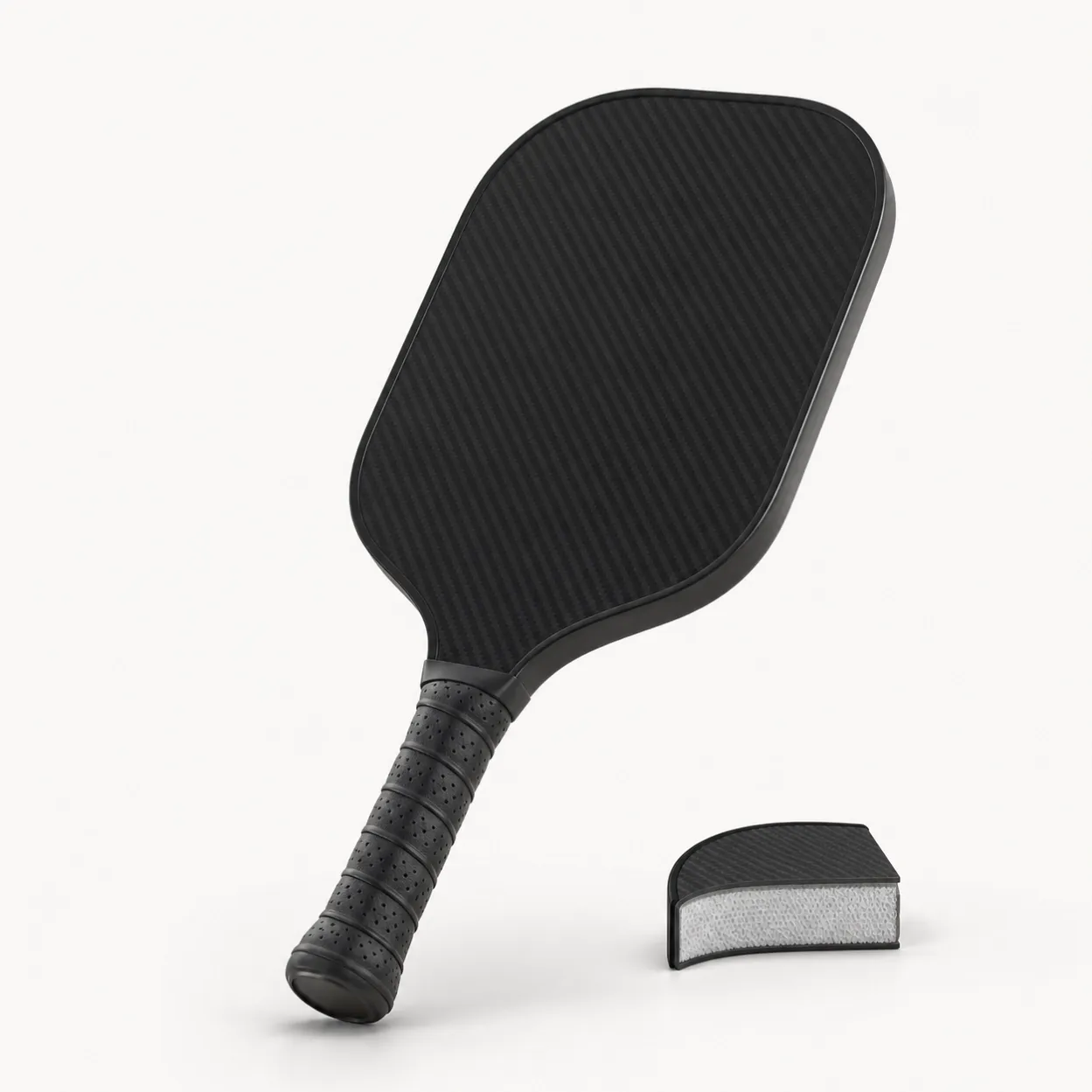
The phrase should describe a material and construction target, not an unverified certification claim. Depending on the model, a performance paddle may use a carbon-fiber or fiberglass face, a polypropylene honeycomb core, structural edge protection, controlled lamination and a grip system designed for repeated play.
The quality of those inputs matters. Two products can use the same general material names and still perform very differently because of fiber grade, resin system, core density, bonding, thickness tolerance and process control.
SYNLY plans paddle materials around measurable requirements rather than adding premium words to a product name.
The material system buyers should evaluate
Face material
The face influences feel, control, power and surface behavior. Buyers should confirm the actual material, finish and production method rather than relying only on a generic “carbon” or “fiberglass” label.
Core structure
Polypropylene honeycomb is common, but cell quality, density, thickness and uniformity affect response and durability. Core selection must match the paddle's intended control and power profile.
Bonding and lamination
Even good face and core materials can fail if bonding is inconsistent. Process temperature, pressure, adhesive control and curing conditions influence delamination risk and long-term stability.
Edge, handle and grip
The edge guard, handle structure, end cap and grip are not secondary details. They affect impact protection, comfort, balance and the way the paddle feels after many sessions.
Quality control must follow the whole paddle
A good-looking sample is only the beginning. For repeat B2B orders, the factory must control production across every batch.
Our quality plan includes checks such as:
- Incoming material identification and lot records
- Face and core thickness
- Bonding and surface inspection
- Paddle length, width and total thickness
- Finished weight and weight range
- Balance-point consistency
- Handle dimensions and grip assembly
- Edge-guard fit
- Visual finish and logo position
- Packaging and carton inspection
- Durability and functional sample tests
The exact inspection plan depends on the model. The principle is constant: approved specifications must become the reference for repeat production.
Why high quality does not require an excessive brand premium
Cost reduction should come from engineering and efficiency, not from quietly replacing important materials.
SYNLY will analyze the real bill of materials, processing steps, yield, labor, packaging and logistics for each paddle program. The goal is to identify waste and unnecessary channel cost while protecting the construction that determines performance.
Practical cost-control methods include:
- Selecting material grades that match the target instead of overspecifying every component
- Standardizing proven core and handle platforms
- Improving material utilization and production yield
- Consolidating compatible colors, logos and packaging
- Planning order quantities around efficient production runs
- Reducing repeated sample changes through clear approval documents
- Shipping in packaging designed for the buyer's channel
- Working factory direct to reduce unnecessary intermediary cost
This is how we aim to create value for distributors, clubs and brand owners: a serious paddle at a rational factory price, with room for the B2B customer to build a sustainable market.
Junior paddles need their own design logic
Children should not simply receive a smaller graphic on an adult paddle. Junior models should consider lower weight, suitable handle circumference, manageable length, comfortable balance, edge protection and age-appropriate packaging.
SYNLY plans junior paddles as a separate product direction for schools, family sets, clubs and beginner programs. Their priorities are ease of use, durability and safe, practical handling—not an adult performance claim placed on a smaller product.
Certification must be model-specific and honest
USA Pickleball equipment approval applies to a specific production-ready paddle model. The organization's submission FAQ states that final graphics, manufacturer name and model name must be present, and approved production units must continue to match the certified specification.
That means a factory should not advertise every future paddle as “approved” simply because it uses a familiar material. Material choice, construction, dimensions, surface characteristics and finished testing all matter.
SYNLY's approach is to complete development, lock the production specification and pursue applicable approval for the relevant models. We will only use an approval claim after the exact model is officially listed.
How SYNLY supports B2B paddle buyers
A distributor or new brand needs more than a paddle. The supply plan may include:
- Small-batch evaluation orders
- Representative samples before volume production
- Adult and junior model combinations
- Logo, color and packaging development
- Weight-range and specification confirmation
- Inspection requirements
- International express, air or sea delivery
- Export and customs-clearance coordination
- Repeat-order and new-product planning
We want the ordering experience to remain as clear as buying through a platform while giving the customer direct access to product and manufacturing decisions.
A practical sample-approval checklist
Before approving a paddle, B2B buyers should record:
- Intended player and price position
- Face and core materials
- Thickness and dimensions
- Weight range and balance target
- Handle length and grip circumference
- Surface and edge finish
- Logo position and print method
- Packaging configuration
- Functional and durability observations
- The exact sample code used as the production reference
A quotation is easier to compare when every supplier is pricing the same specification.
Frequently asked questions
Will SYNLY focus only on premium paddles?
No. Our main direction is high-quality, performance-oriented adult paddles, but the product system can also include club, training, retail-set and junior paddles. Each model will have a clear use case and cost target.
Does “competition-oriented material” mean the paddle is already certified?
No. It describes the development target. Approval is model-specific and should be claimed only after the finished production model completes the applicable official process.
Can a distributor start with a small order?
SYNLY can discuss small-batch evaluation orders. The practical minimum depends on the model, materials, graphics and packaging.
Can buyers test samples first?
Yes. Representative sample approval is an important part of the process. Qualified B2B projects can discuss evaluation samples and shipping arrangements before volume production.
Can SYNLY make junior paddles?
Yes. Junior paddles are part of the planned product range, with separate attention to weight, grip, dimensions, durability and user age.
How does SYNLY control paddle cost?
We calculate materials, processing, yield, packaging and logistics, then reduce avoidable production and channel costs. We do not treat material downgrading as the default way to reach a price.
Can SYNLY support private-label paddles?
Yes. Logo, graphics, color, packaging and model combinations can be discussed after the product specification and order plan are clear.
Build a paddle program with SYNLY
Tell us your target player, market, price range, preferred materials, quantity, logo and packaging requirements. We will help turn those requirements into a sample and a realistic factory-direct supply plan.
Sources and further reading
- USA Pickleball Equipment Standards Manual: https://equipment.usapickleball.org/docs/Equipment-Standards-Manual.pdf
- USA Pickleball Equipment Submission FAQ: https://equipment.usapickleball.org/equipment-submission-faq/
- USA Pickleball Approved Paddle List: https://equipment.usapickleball.org/paddle-list/